
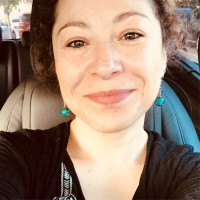
Psychologist and social worker, community manager, and Chilean immigrant residing in New York, with a career marked by commitment to people, inclusion, and the strengthening of communities.
She currently serves as Director of Social Services at the Joan & Alan Bernikow JCC of Staten Island, where she leads initiatives for social support, well-being, and mental health, coordinating collaboration networks among organizations and communities in New York.
Her personal history has had a profound influence on her vocation. She grew up in Chile during the military dictatorship and experienced exile with her family, circumstances that helped develop a special sensitivity towards people and communities facing vulnerability, displacement, and exclusion.
Her training began in the field of art conservation in Chile. Later, she came to the United States to complete a curatorial internship at the Museum of Modern Art (MoMA) in New York. During this experience, working in art workshops aimed at women and the elderly opened a new professional path, directing her vocation towards social and community development.
In the United States, she continued her academic training at the College of Staten Island of the City University of New York (CUNY), where she earned a bachelor's degree in Psychology and later a Master of Social Work (MSW).
Her professional career thus combines dimensions that rarely converge in a single profile: art, culture, psychology, social work, migration, and community building. This interdisciplinary perspective has allowed her to understand identity and culture not only as symbolic expressions but also as tools capable of generating belonging, bonds, and social transformation.
In April 2026, she was honored with the Community Service Award from Nonprofit Staten Island, recognizing her career and work developed in favor of communities and people requiring greater support networks.
Her incorporation into the South American Pantone team brings precisely that convergence between artistic sensitivity, social experience, and understanding of cultural diversity. From her own experience between Chile and the United States, Paloma contributes to thinking about color as more than an aesthetic decision: as an expression of memory, identity, territory, diversity, and encounter among communities.